🎈 Simple reactive notebooks for Julia
npm install pluto.jlInstall Pluto
Installing Pluto is easy! Start Julia, and run:
import Pluto
Pluto.run()
See plutojl.org/#install for a complete guide to install Julia and Pluto!
Writing a notebook is not just about writing the final document — Pluto empowers the experiments and discoveries that are essential to getting there.
Explore models and share results in a notebook that is
- reactive - when changing a function or variable, Pluto automatically updates all affected cells.
- lightweight - Pluto is written in pure Julia and is easy to install.
- simple - no hidden workspace state; friendly UI.
🎈 Pluto demo inside your browser 🎈
Input
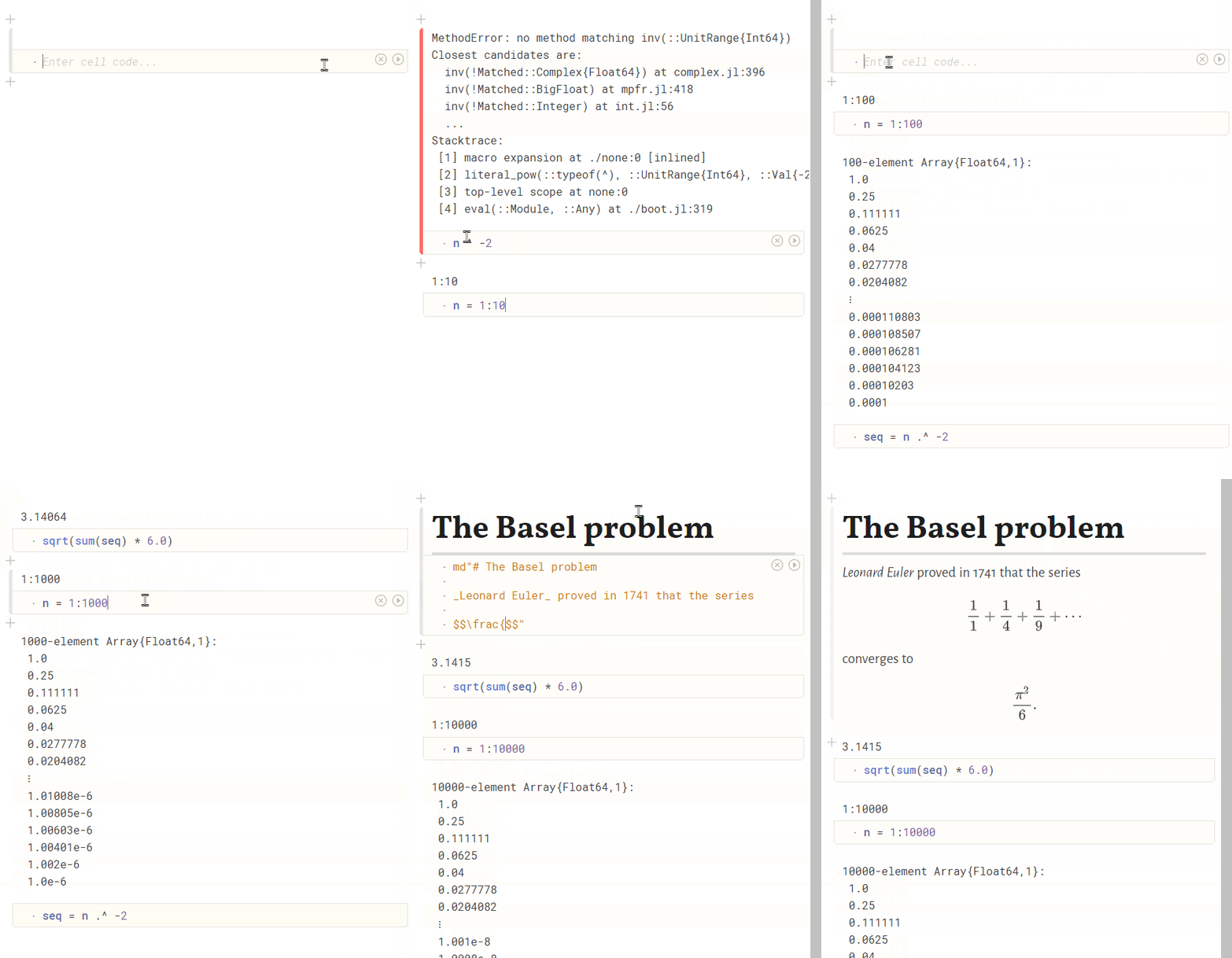
A Pluto notebook is made up of small blocks of Julia code (cells) and together they form a reactive notebook. When you change a variable, Pluto automatically re-runs the cells that refer to it. Cells can even be placed in arbitrary order - intelligent syntax analysis figures out the dependencies between them and takes care of execution.
Cells can contain arbitrary Julia code, and you can use external libraries. There are no code rewrites or wrappers, Pluto just looks at your code once before evaluation.
Output
Your notebooks are saved as pure Julia files (sample), which you can then import as if you had been programming in a regular editor all along. You can also export your notebook with cell outputs as attractive HTML and PDF documents. By reordering cells and hiding code, you have full control over how you tell your story.
🎈 Pluto – introduction (20 min) at Juliacon 2020 🎈
🌐 Pluto – one year later (25 min) at Juliacon 2021 🌐
🪐 Pluto – reactive and reproducible (25 min) at JupyterCon 2023 🪐
🌝 Pluto 1.0 release announcement (10 min read) on Discourse 2026 🪐
Dynamic environment
Pluto offers an environment where changed code takes effect instantly and where deleted code leaves no trace. Unlike Jupyter or Matlab, there is no mutable workspace, but rather, an important guarantee:
At any instant, the program state is completely described by the code you see.No hidden state, no hidden bugs.
Interactivity
Your programming environment becomes interactive by splitting your code into multiple cells! Changing one cell instantly shows effects on all other cells, giving you a fast and fun way to experiment with your model.
In the example below, changing the parameter A and running the first cell will directly re-evaluate the second cell and display the new plot.
Built-in package manager
Pluto uses syntax analysis to understand which packages are being used in a notebook, and it automatically manages a package environment for your notebook. You no longer need to install packages, you can directly import any registered package like Plots or DataFrames and use it.
To ensure reproducibility, the information to exactly reproduce the package environment is stored in your notebook file. When someone else opens your notebook with Pluto, the exact same package environment will be used, and packages will work on their computer, automatically! more info

Interactivity with @bind
Lastly, here's one more feature: Pluto notebooks have a @bind macro to create a live bond between an browser widget and a Julia variable. Combined with reactivity, this is a very powerful tool!
The PlutoUI package contains basic inputs like sliders, buttons, and much more! Read the docs →
For those who want to dive deeper - you can use Julia, HTML, JavaScript and CSS to write your own widgets! Learn more →
Pluto for teaching
Pluto was developed alongside the free online course Introduction to Computational Thinking at MIT, with the goal of creating a programming environment that is powerful, helpful and interactive, without being too intimidating for students and teachers.
Are you interested in using Pluto for your class? Here are some presentations by people who are using it already: the MIT team, Gerhard Dorn, Daniel Molina, Henki W. Ashadi and Max Köhler.
https://user-images.githubusercontent.com/6933510/134824521-7cefa38a-7102-4767-bee4-777caf30ba47.mp4
(video) Grant Sanderson (3Blue1Brown) using Pluto's interactivity to teach Computational Thinking at MIT!
Let's do it!
See plutojl.org/#install for an easy guide to install Pluto!
Questions and Help
Questions? Have a look at the FAQ and the documentation.

Interested in learning Julia, Pluto and applied mathematics? Join the open MIT course taught by Alan Edelman, David P. Sanders & Grant Sanderson (3blue1brown) (and a bit of me): Introduction to Computational Thinking, Spring 2021.
Contribute to Pluto
Follow these instructions to start working on the package.

License
Pluto.jl is open source! Specifically, it is MIT Licensed. Pluto.jl is built by gluing together open source software:
Julia- licenseCodeMirror- licenseHTTP.jl- licenseMsgPack.jl- licensemsgpack-lite- licenseobservablehq/stdlib- licensepreact- licensedevelopit/htm- licenseMathJax- license
If you want to reference Pluto.jl in scientific writing, you can use our DOI: 
Featured notebooks
Unless otherwise specified, the included featured notebooks have a more permissive license: the Unlicense. This means that you can use them however you like - you do not need to credit us!
Your notebook files are yours, you also do not need to credit us. Have fun!
From the authors
The Pluto project is an ambition to rethink what a programming environment should be. We believe that scientific computing can be a lot simpler and more accessible. If you feel the same, give Pluto a try! We would love to hear what you think. 😊
You can chat with us
- talk with fellow Pluto users in the Zulip chat room (search for the
pluto.jlstream) - use Pluto's built-in feedback system:
- contact fons via email
Questions? Have a look at the FAQ.
Sponsors
Development of Pluto.jl is partially sponsored by
|
The free online course Introduction to Computational Thinking at MIT uses Pluto notebooks to teach scientific computing in a new way. Homeworks react to the student in realtime, with live answer checks and visualizations while you solve problems. |
 |
QuEra Computing uses a Pluto notebook as an online dashboard to control their quantum computer! |
 |
JuliaHub enables the creation and editing of Pluto notebooks on the cloud! |
 |
The mission of NumFOCUS is to promote open practices in research, data, and scientific computing by serving as a fiscal sponsor for open source projects and organizing community-driven educational programs. |
 |
Fons works at TU Eindhoven to make the course Bayesian Machine Learning and Information Processing interactive. |
Created by Fons van der Plas, Mikołaj Bochenski, Michiel Dral, Παναγιώτης (Panagiotis) Γεωργακόπουλος, Paul Berg and friends. Inspired by Observable.