Proto Actor - Ultra fast distributed actors for Go, C# and Java/Kotlin
💬 Join our Slack channel
Proto.Actor
Ultra-fast, distributed, cross-platform actors.
Bootcamp Training
https://github.com/AsynkronIT/protoactor-bootcamp
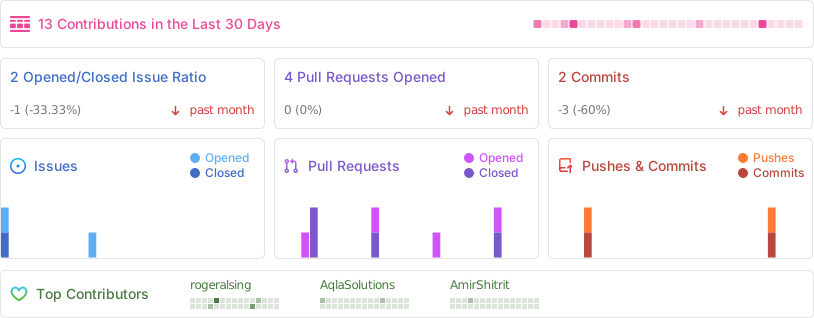
Stats
Installing
Using NuGet Package Manager Console:
PM> Install-Package Proto.Actor
Source code
This is the .NET repository for Proto Actor.
Other implementations:
Documentation
Additional root-level documents provide deeper insights into the project:
- CODEBASE_OVERVIEW.md – overview of the repository structure and key concepts.
- CLUSTER_MEMBERSHIP_GOSSIP.md – explains how cluster membership is detected and propagated via gossip.
- EVENTSTREAM_EVENTS.md – lists key EventStream events and their publishers/subscribers.
- SECURITY.md – security policy and supported versions.
- Terminology.md – definitions of common Proto.Actor terms.
Test coverage
You can capture code coverage directly when running the test projects. The .NET SDK ships an XPlat Code Coverage data collector that works across platforms, so you do not need any third-party tooling for the basic workflow.
Quick coverage run
Run any test project with coverage enabled by passing the CollectCoverage property:
dotnet test /p:CollectCoverage=true
This uses the built-in collector and writes coverage data under the TestResults directory for the invocation.
Using coverlet.collector
For richer reporting support you can opt into the coverlet.collector package. Add it to the test project you want to analyze:
dotnet add package coverlet.collector
Then request coverage when running the tests:
dotnet test --collect:"XPlat Code Coverage"
This produces a .coverage file under TestResults/... that can be converted into other formats.
Alternative output formats
You can ask the collector to emit other formats such as Cobertura, lcov, or OpenCover. For example, to produce an lcov report:
dotnet test --collect:"XPlat Code Coverage" -- DataCollectionRunSettings.DataCollectors.DataCollector.Configuration.Format=lcov
HTML reports
Feed the generated lcov or cobertura files into tools like ReportGenerator to build browsable HTML output. Install the global tool and point it at your coverage reports:
dotnet tool install -g dotnet-reportgenerator-globaltool
reportgenerator -reports:**/coverage.cobertura.xml -targetdir:coveragereport
Open the files in the coveragereport directory to inspect the results.
Design principles
Minimalistic API - The API should be small and easy to use. Avoid enterprisey containers and configurations.
Build on existing technologies - There are already a lot of great technologies for e.g. networking and clustering. Build on those instead of reinventing them. E.g. gRPC streams for networking, Consul for clustering.
Pass data, not objects - Serialization is an explicit concern - don't try to hide it. Protobuf all the way.
Be fast - Do not trade performance for magic API trickery.
Getting started
The best place currently for learning how to use Proto.Actor is the examples. Documentation and guidance is under way, but not yet complete, and can be found on the website.
Hello world
Define a message type:
internal record Hello(string Who);
Define an actor:
internal class HelloActor : IActor
{
    public Task ReceiveAsync(IContext context)
    {
        var msg = context.Message;
        if (msg is Hello r)
        {
            Console.WriteLine($"Hello {r.Who}");
        }
        return Task.CompletedTask;
    }
}
Spawn it and send a message to it:
var system = new ActorSystem();
var context = system.Root;
var props = Props.FromProducer(() => new HelloActor());
var pid = context.Spawn(props);

context.Send(pid, new Hello("Alex"));
You should see the output Hello Alex.
Sample application
https://github.com/asynkron/realtimemap-dotnet
Contributors
Made with contributors-img.
Partners, Sponsors, and Contributor Companies
| Name | Role |
|---|---|
| Asynkron AB | Founder and owner of Proto.Actor |
| Helleborg AS | Core contributor team |
| Ubiquitous AS | Core contributor team |
| Ahoy Games | Core contributor team |
| Etteplan | Contributing tutorials, documentation |