Interactive data visualizations and plotting in Julia








Makie is an interactive data visualization and plotting ecosystem for the Julia programming language, available on Windows, Linux and Mac. The backend packages GLMakie, WGLMakie, CairoMakie and RPRMakie add different functionalities: You can use Makie to interactively explore your data and create simple GUIs in native windows or web browsers, export high-quality vector graphics or even raytrace with physically accurate lighting.
The name Makie (we pronounce it Mah-kee) is derived from the japanese word Maki-e, which is a technique to sprinkle lacquer with gold and silver powder. Data is the gold and silver of our age, so let's spread it out beautifully on the screen!
To learn more, we invite you to visit the documentation at docs.makie.org.
Citing Makie
If you use Makie for a scientific publication, please acknowledge and support our work by citing our JOSS paper the following way:
Danisch & Krumbiegel, (2021). Makie.jl: Flexible high-performance data visualization for Julia.
Journal of Open Source Software, 6(65), 3349, https://doi.org/10.21105/joss.03349
BibTeX entry:
@article{DanischKrumbiegel2021,
  doi = {10.21105/joss.03349},
  url = {https://doi.org/10.21105/joss.03349},
  year = {2021},
  publisher = {The Open Journal},
  volume = {6},
  number = {65},
  pages = {3349},
  author = {Simon Danisch and Julius Krumbiegel},
  title = {{Makie.jl}: Flexible high-performance data visualization for {Julia}},
  journal = {Journal of Open Source Software}
}
Community Channels
We are on Discord and Discourse! Community channels are a great way for you to ask questions and get help. Please join us!
Installation
Choose one or more backend packages: GLMakie (interactive OpenGL in native OS windows), WGLMakie (interactive WebGL in browsers, IDEs, notebooks), CairoMakie (static 2D vector graphics and images) and RPRMakie (raytracing). Each backend re-exports all of Makie.jl so you don't have to install or load it explicitly.
Install:
julia>]
pkg> add GLMakie
Check the installed version:
]st GLMakie
Start using the package:
using GLMakie
Developing Makie
🔥 Click for more 🔥
Makie and its backends all live in the Makie monorepo. This makes it easier to change code across all packages. Therefore, dev'ing Makie almost works as with other Julia packages, just, that one needs to also dev the sub packages:
# local will clone the repository at ./dev/Makie
# Pkg is smart enough to dev the backends at `/dev/Makie/GLMakie` for the below
]dev --local Makie GLMakie CairoMakie WGLMakie RPRMakie
To run the tests, you also should add:
]dev dev/Makie/ReferenceTests
For more info about ReferenceTests, check out its README
Examples
The following examples are supposed to be self-explanatory. For further information check out the documentation!
A simple parabola
x = 1:0.1:10
fig = lines(x, x.^2; label = "Parabola",
    axis = (; xlabel = "x", ylabel = "y", title ="Title"),
    figure = (; size = (800,600), fontsize = 22))
axislegend(; position = :lt)
save("./images/parabola.png", fig)
fig

A more complex plot with unicode characters and LaTeX strings:
Similar to the one on this link
Show Code
x = -2pi:0.1:2pi
approx = fill(0.0, length(x))
cmap = [:gold, :deepskyblue3, :orangered, "#e82051"]
with_theme(palette = (; patchcolor = cgrad(cmap, alpha=0.45))) do
    fig, axis, lineplot = lines(x, sin.(x); label = L"sin(x)", linewidth = 3, color = :black,
        axis = (; title = "Polynomial approximation of sin(x)",
            xgridstyle = :dash, ygridstyle = :dash,
            xticksize = 10, yticksize = 10, xtickalign = 1, ytickalign = 1,
            xticks = (-π:π/2:π, ["π", "-π/2", "0", "π/2", "π"])
        ))
    translate!(lineplot, 0, 0, 2) # move line to foreground
    band!(x, sin.(x), approx .+= x; label = L"n = 0")
    band!(x, sin.(x), approx .+= -x .^ 3 / 6; label = L"n = 1")
    band!(x, sin.(x), approx .+= x .^ 5 / 120; label = L"n = 2")
    band!(x, sin.(x), approx .+= -x .^ 7 / 5040; label = L"n = 3")
    limits!(-3.8, 3.8, -1.5, 1.5)
    axislegend(; position = :ct, backgroundcolor = (:white, 0.75), framecolor = :orange)
    save("./images/approxsin.png", fig, size = (800, 600))
    fig
end

Simple layout: Heatmap, contour and 3D surface plot
Show Code
x = y = -5:0.5:5
z = x .^ 2 .+ y' .^ 2
cmap = :plasma
with_theme(colormap = cmap) do
    fig = Figure(fontsize = 22)
    ax3d = Axis3(fig[1, 1]; aspect = (1, 1, 1),
        perspectiveness = 0.5, azimuth = 2.19, elevation = 0.57)
    ax2d = Axis(fig[1, 2]; aspect = 1, xlabel = "x", ylabel="y")
    pltobj = surface!(ax3d, x, y, z; transparency = true)
    heatmap!(ax2d, x, y, z; colormap = (cmap, 0.65))
    contour!(ax2d, x, y, z; linewidth = 2, levels = 12, color = :black)
    contour3d!(ax3d, x, y, z; linewidth = 4, levels = 12,
        transparency = true)
    Colorbar(fig[1, 3], pltobj; label="z", labelrotation=pi)
    colsize!(fig.layout, 1, Aspect(1, 1.0))
    colsize!(fig.layout, 2, Aspect(1, 1.0))
    resize_to_layout!(fig)
    save("./images/simpleLayout.png", fig)
    fig
end

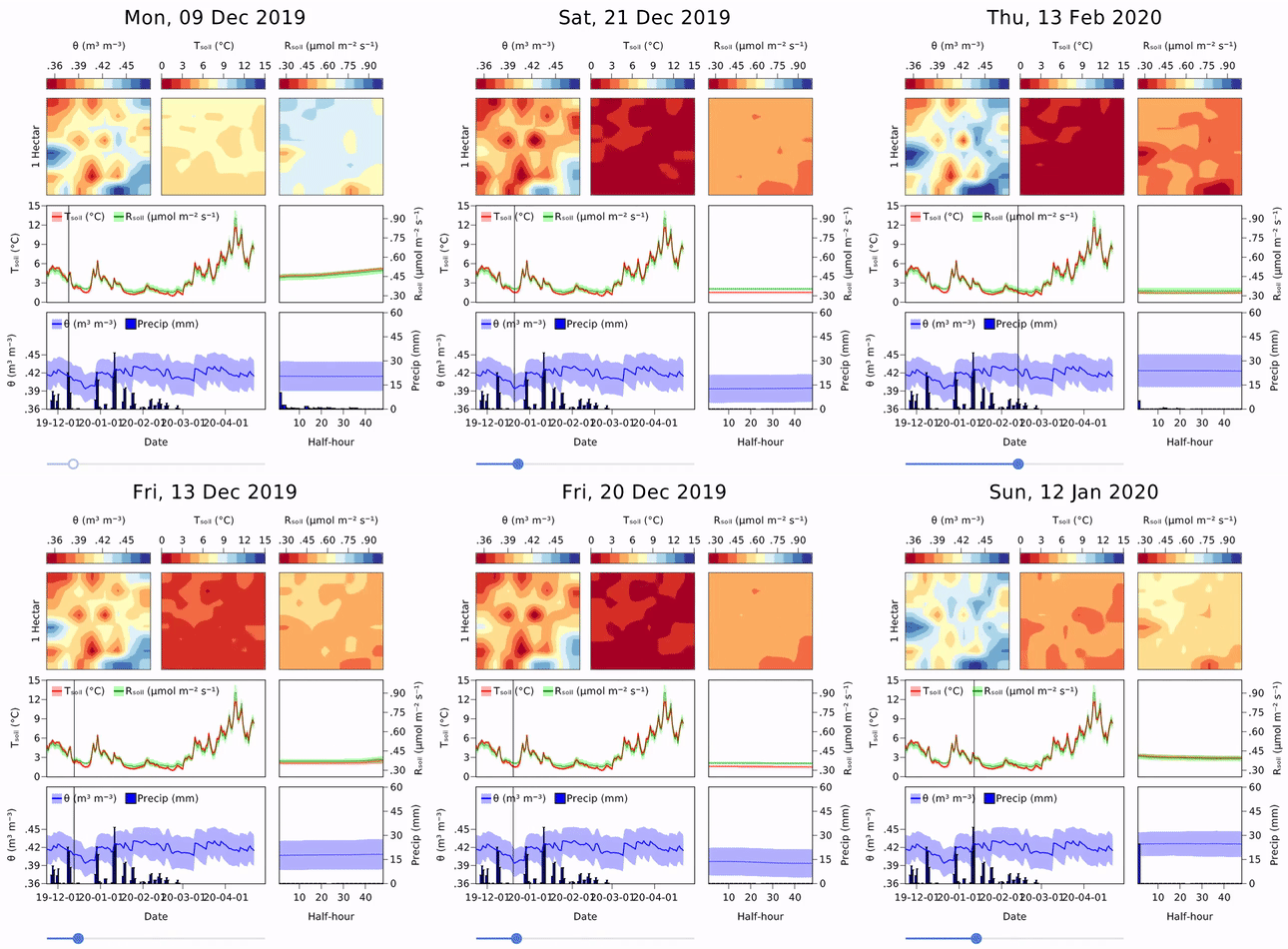
Interactive example by AlexisRenchon:
Example from InteractiveChaos.jl

Sponsors
 Förderkennzeichen: 01IS10S27, 2020