srush/GPU-Puzzles
Jupyter NotebookSolve puzzles. Learn CUDA.
GPU Puzzles
- by Sasha Rush - srush_nlp

GPU architectures are critical to machine learning, and seem to be becoming even more important every day. However, you can be an expert in machine learning without ever touching GPU code. It is hard to gain intuition working through abstractions.
This notebook is an attempt to teach beginner GPU programming in a completely interactive fashion. Instead of providing text with concepts, it throws you right into coding and building GPU kernels. The exercises use NUMBA which directly maps Python code to CUDA kernels. It looks like Python but is basically identical to writing low-level CUDA code. In a few hours, I think you can go from basics to understanding the real algorithms that power 99% of deep learning today. If you do want to read the manual, it is here:
I recommend doing these in Colab, as it is easy to get started. Be
sure to make your own copy, turn on GPU mode in the settings (Runtime / Change runtime type, then set Hardware accelerator to GPU), and
then get to coding.

(If you are into this style of puzzle, also check out my Tensor Puzzles for PyTorch.)
!pip install -qqq git+https://github.com/danoneata/chalk@srush-patch-1
!wget -q https://github.com/srush/GPU-Puzzles/raw/main/robot.png https://github.com/srush/GPU-Puzzles/raw/main/lib.py
import numba
import numpy as np
import warnings
from lib import CudaProblem, Coord
warnings.filterwarnings(
    action="ignore", category=numba.NumbaPerformanceWarning, module="numba"
)
Puzzle 1: Map
Implement a "kernel" (GPU function) that adds 10 to each position of vector a
and stores it in vector out. You have 1 thread per position.
Warning This code looks like Python but it is really CUDA! You cannot use standard python tools like list comprehensions or ask for Numpy properties like shape or size (if you need the size, it is given as an argument). The puzzles only require doing simple operations, basically +, *, simple array indexing, for loops, and if statements. You are allowed to use local variables. If you get an error it is probably because you did something fancy :).
Tip: Think of the function call as being run 1 time for each thread.
The only difference is that cuda.threadIdx.x changes each time.
def map_spec(a):
    return a + 10


def map_test(cuda):
    def call(out, a) -> None:
        local_i = cuda.threadIdx.x
        # FILL ME IN (roughly 1 lines)

    return call


SIZE = 4
out = np.zeros((SIZE,))
a = np.arange(SIZE)
problem = CudaProblem(
    "Map", map_test, [a], out, threadsperblock=Coord(SIZE, 1), spec=map_spec
)
problem.show()
# Map

   Score (Max Per Thread):
   |  Global Reads | Global Writes |  Shared Reads | Shared Writes |
   |             0 |             0 |             0 |             0 |

problem.check()
Failed Tests.
Yours: [0. 0. 0. 0.]
Spec : [10 11 12 13]
Puzzle 2 - Zip
Implement a kernel that adds together each position of a and b and stores it in out.
You have 1 thread per position.
def zip_spec(a, b):
    return a + b


def zip_test(cuda):
    def call(out, a, b) -> None:
        local_i = cuda.threadIdx.x
        # FILL ME IN (roughly 1 lines)

    return call


SIZE = 4
out = np.zeros((SIZE,))
a = np.arange(SIZE)
b = np.arange(SIZE)
problem = CudaProblem(
    "Zip", zip_test, [a, b], out, threadsperblock=Coord(SIZE, 1), spec=zip_spec
)
problem.show()
# Zip

   Score (Max Per Thread):
   |  Global Reads | Global Writes |  Shared Reads | Shared Writes |
   |             0 |             0 |             0 |             0 |

problem.check()
Failed Tests.
Yours: [0. 0. 0. 0.]
Spec : [0 2 4 6]
Puzzle 3 - Guards
Implement a kernel that adds 10 to each position of a and stores it in out.
You have more threads than positions.
def map_guard_test(cuda):
    def call(out, a, size) -> None:
        local_i = cuda.threadIdx.x
        # FILL ME IN (roughly 2 lines)

    return call


SIZE = 4
out = np.zeros((SIZE,))
a = np.arange(SIZE)
problem = CudaProblem(
    "Guard",
    map_guard_test,
    [a],
    out,
    [SIZE],
    threadsperblock=Coord(8, 1),
    spec=map_spec,
)
problem.show()
# Guard

   Score (Max Per Thread):
   |  Global Reads | Global Writes |  Shared Reads | Shared Writes |
   |             0 |             0 |             0 |             0 |

problem.check()
Failed Tests.
Yours: [0. 0. 0. 0.]
Spec : [10 11 12 13]
Puzzle 4 - Map 2D
Implement a kernel that adds 10 to each position of a and stores it in out.
Input a is 2D and square. You have more threads than positions.
def map_2D_test(cuda):
    def call(out, a, size) -> None:
        local_i = cuda.threadIdx.x
        local_j = cuda.threadIdx.y
        # FILL ME IN (roughly 2 lines)

    return call


SIZE = 2
out = np.zeros((SIZE, SIZE))
a = np.arange(SIZE * SIZE).reshape((SIZE, SIZE))
problem = CudaProblem(
    "Map 2D", map_2D_test, [a], out, [SIZE], threadsperblock=Coord(3, 3), spec=map_spec
)
problem.show()
# Map 2D

   Score (Max Per Thread):
   |  Global Reads | Global Writes |  Shared Reads | Shared Writes |
   |             0 |             0 |             0 |             0 |

problem.check()
Failed Tests.
Yours: [[0. 0.]
 [0. 0.]]
Spec : [[10 11]
 [12 13]]
Puzzle 5 - Broadcast
Implement a kernel that adds a and b and stores it in out.
Inputs a and b are vectors. You have more threads than positions.
def broadcast_test(cuda):
    def call(out, a, b, size) -> None:
        local_i = cuda.threadIdx.x
        local_j = cuda.threadIdx.y
        # FILL ME IN (roughly 2 lines)

    return call


SIZE = 2
out = np.zeros((SIZE, SIZE))
a = np.arange(SIZE).reshape(SIZE, 1)
b = np.arange(SIZE).reshape(1, SIZE)
problem = CudaProblem(
    "Broadcast",
    broadcast_test,
    [a, b],
    out,
    [SIZE],
    threadsperblock=Coord(3, 3),
    spec=zip_spec,
)
problem.show()
# Broadcast

   Score (Max Per Thread):
   |  Global Reads | Global Writes |  Shared Reads | Shared Writes |
   |             0 |             0 |             0 |             0 |

problem.check()
Failed Tests.
Yours: [[0. 0.]
 [0. 0.]]
Spec : [[0 1]
 [1 2]]
Puzzle 6 - Blocks
Implement a kernel that adds 10 to each position of a and stores it in out.
You have fewer threads per block than the size of a.
Tip: A block is a group of threads. The number of threads per block is limited, but we can
have many different blocks. Variable cuda.blockIdx tells us what block we are in.
def map_block_test(cuda):
    def call(out, a, size) -> None:
        i = cuda.blockIdx.x * cuda.blockDim.x + cuda.threadIdx.x
        # FILL ME IN (roughly 2 lines)

    return call


SIZE = 9
out = np.zeros((SIZE,))
a = np.arange(SIZE)
problem = CudaProblem(
    "Blocks",
    map_block_test,
    [a],
    out,
    [SIZE],
    threadsperblock=Coord(4, 1),
    blockspergrid=Coord(3, 1),
    spec=map_spec,
)
problem.show()
# Blocks

   Score (Max Per Thread):
   |  Global Reads | Global Writes |  Shared Reads | Shared Writes |
   |             0 |             0 |             0 |             0 |

problem.check()
Failed Tests.
Yours: [0. 0. 0. 0. 0. 0. 0. 0. 0.]
Spec : [10 11 12 13 14 15 16 17 18]
Puzzle 7 - Blocks 2D
Implement the same kernel in 2D. You have fewer threads per block
than the size of a in both directions.
def map_block2D_test(cuda):
    def call(out, a, size) -> None:
        i = cuda.blockIdx.x * cuda.blockDim.x + cuda.threadIdx.x
        # FILL ME IN (roughly 4 lines)

    return call


SIZE = 5
out = np.zeros((SIZE, SIZE))
a = np.ones((SIZE, SIZE))

problem = CudaProblem(
    "Blocks 2D",
    map_block2D_test,
    [a],
    out,
    [SIZE],
    threadsperblock=Coord(3, 3),
    blockspergrid=Coord(2, 2),
    spec=map_spec,
)
problem.show()
# Blocks 2D

   Score (Max Per Thread):
   |  Global Reads | Global Writes |  Shared Reads | Shared Writes |
   |             0 |             0 |             0 |             0 |

problem.check()
Failed Tests.
Yours: [[0. 0. 0. 0. 0.]
 [0. 0. 0. 0. 0.]
 [0. 0. 0. 0. 0.]
 [0. 0. 0. 0. 0.]
 [0. 0. 0. 0. 0.]]
Spec : [[11. 11. 11. 11. 11.]
 [11. 11. 11. 11. 11.]
 [11. 11. 11. 11. 11.]
 [11. 11. 11. 11. 11.]
 [11. 11. 11. 11. 11.]]
Puzzle 8 - Shared
Implement a kernel that adds 10 to each position of a and stores it in out.
You have fewer threads per block than the size of a.
Warning: Each block can only have a constant amount of shared
memory that threads in that block can read and write to. This needs
to be a literal python constant not a variable. After writing to
shared memory you need to call cuda.syncthreads to ensure that
threads do not cross.
(This example does not really need shared memory or syncthreads, but it is a demo.)
TPB = 4
def shared_test(cuda):
    def call(out, a, size) -> None:
        shared = cuda.shared.array(TPB, numba.float32)
        i = cuda.blockIdx.x * cuda.blockDim.x + cuda.threadIdx.x
        local_i = cuda.threadIdx.x

        if i < size:
            shared[local_i] = a[i]
            cuda.syncthreads()

        # FILL ME IN (roughly 2 lines)

    return call


SIZE = 8
out = np.zeros(SIZE)
a = np.ones(SIZE)
problem = CudaProblem(
    "Shared",
    shared_test,
    [a],
    out,
    [SIZE],
    threadsperblock=Coord(TPB, 1),
    blockspergrid=Coord(2, 1),
    spec=map_spec,
)
problem.show()
# Shared

   Score (Max Per Thread):
   |  Global Reads | Global Writes |  Shared Reads | Shared Writes |
   |             1 |             0 |             0 |             1 |

problem.check()
Failed Tests.
Yours: [0. 0. 0. 0. 0. 0. 0. 0.]
Spec : [11. 11. 11. 11. 11. 11. 11. 11.]
Puzzle 9 - Pooling
Implement a kernel that sums together the last 3 position of a and stores it in out.
You have 1 thread per position. You only need 1 global read and 1 global write per thread.
Tip: Remember to be careful about syncing.
def pool_spec(a):
    out = np.zeros(*a.shape)
    for i in range(a.shape[0]):
        out[i] = a[max(i - 2, 0) : i + 1].sum()
    return out


TPB = 8
def pool_test(cuda):
    def call(out, a, size) -> None:
        shared = cuda.shared.array(TPB, numba.float32)
        i = cuda.blockIdx.x * cuda.blockDim.x + cuda.threadIdx.x
        local_i = cuda.threadIdx.x
        # FILL ME IN (roughly 8 lines)

    return call


SIZE = 8
out = np.zeros(SIZE)
a = np.arange(SIZE)
problem = CudaProblem(
    "Pooling",
    pool_test,
    [a],
    out,
    [SIZE],
    threadsperblock=Coord(TPB, 1),
    blockspergrid=Coord(1, 1),
    spec=pool_spec,
)
problem.show()
# Pooling

   Score (Max Per Thread):
   |  Global Reads | Global Writes |  Shared Reads | Shared Writes |
   |             0 |             0 |             0 |             0 |

problem.check()
Failed Tests.
Yours: [0. 0. 0. 0. 0. 0. 0. 0.]
Spec : [ 0.  1.  3.  6.  9. 12. 15. 18.]
Puzzle 10 - Dot Product
Implement a kernel that computes the dot-product of a and b and stores it in out.
You have 1 thread per position. You only need 2 global reads and 1 global write per thread.
Note: For this problem you don't need to worry about number of shared reads. We will handle that challenge later.
def dot_spec(a, b):
    return a @ b

TPB = 8
def dot_test(cuda):
    def call(out, a, b, size) -> None:
        shared = cuda.shared.array(TPB, numba.float32)

        i = cuda.blockIdx.x * cuda.blockDim.x + cuda.threadIdx.x
        local_i = cuda.threadIdx.x
        # FILL ME IN (roughly 9 lines)
    return call


SIZE = 8
out = np.zeros(1)
a = np.arange(SIZE)
b = np.arange(SIZE)
problem = CudaProblem(
    "Dot",
    dot_test,
    [a, b],
    out,
    [SIZE],
    threadsperblock=Coord(SIZE, 1),
    blockspergrid=Coord(1, 1),
    spec=dot_spec,
)
problem.show()
# Dot

   Score (Max Per Thread):
   |  Global Reads | Global Writes |  Shared Reads | Shared Writes |
   |             0 |             0 |             0 |             0 |

problem.check()
Failed Tests.
Yours: [0.]
Spec : 140
Puzzle 11 - 1D Convolution
Implement a kernel that computes a 1D convolution between a and b and stores it in out.
You need to handle the general case. You only need 2 global reads and 1 global write per thread.
def conv_spec(a, b):
    out = np.zeros(*a.shape)
    len = b.shape[0]
    for i in range(a.shape[0]):
        out[i] = sum([a[i + j] * b[j] for j in range(len) if i + j < a.shape[0]])
    return out


MAX_CONV = 4
TPB = 8
TPB_MAX_CONV = TPB + MAX_CONV
def conv_test(cuda):
    def call(out, a, b, a_size, b_size) -> None:
        i = cuda.blockIdx.x * cuda.blockDim.x + cuda.threadIdx.x
        local_i = cuda.threadIdx.x

        # FILL ME IN (roughly 17 lines)

    return call


# Test 1

SIZE = 6
CONV = 3
out = np.zeros(SIZE)
a = np.arange(SIZE)
b = np.arange(CONV)
problem = CudaProblem(
    "1D Conv (Simple)",
    conv_test,
    [a, b],
    out,
    [SIZE, CONV],
    Coord(1, 1),
    Coord(TPB, 1),
    spec=conv_spec,
)
problem.show()
# 1D Conv (Simple)

   Score (Max Per Thread):
   |  Global Reads | Global Writes |  Shared Reads | Shared Writes |
   |             0 |             0 |             0 |             0 |

problem.check()
Failed Tests.
Yours: [0. 0. 0. 0. 0. 0.]
Spec : [ 5.  8. 11. 14.  5.  0.]
Test 2
out = np.zeros(15)
a = np.arange(15)
b = np.arange(4)
problem = CudaProblem(
    "1D Conv (Full)",
    conv_test,
    [a, b],
    out,
    [15, 4],
    Coord(2, 1),
    Coord(TPB, 1),
    spec=conv_spec,
)
problem.show()
# 1D Conv (Full)

   Score (Max Per Thread):
   |  Global Reads | Global Writes |  Shared Reads | Shared Writes |
   |             0 |             0 |             0 |             0 |

problem.check()
Failed Tests.
Yours: [0. 0. 0. 0. 0. 0. 0. 0. 0. 0. 0. 0. 0. 0. 0.]
Spec : [14. 20. 26. 32. 38. 44. 50. 56. 62. 68. 74. 80. 41. 14.  0.]
Puzzle 12 - Prefix Sum
Implement a kernel that computes a sum over a and stores it in out.
If the size of a is greater than the block size, only store the sum of
each block.
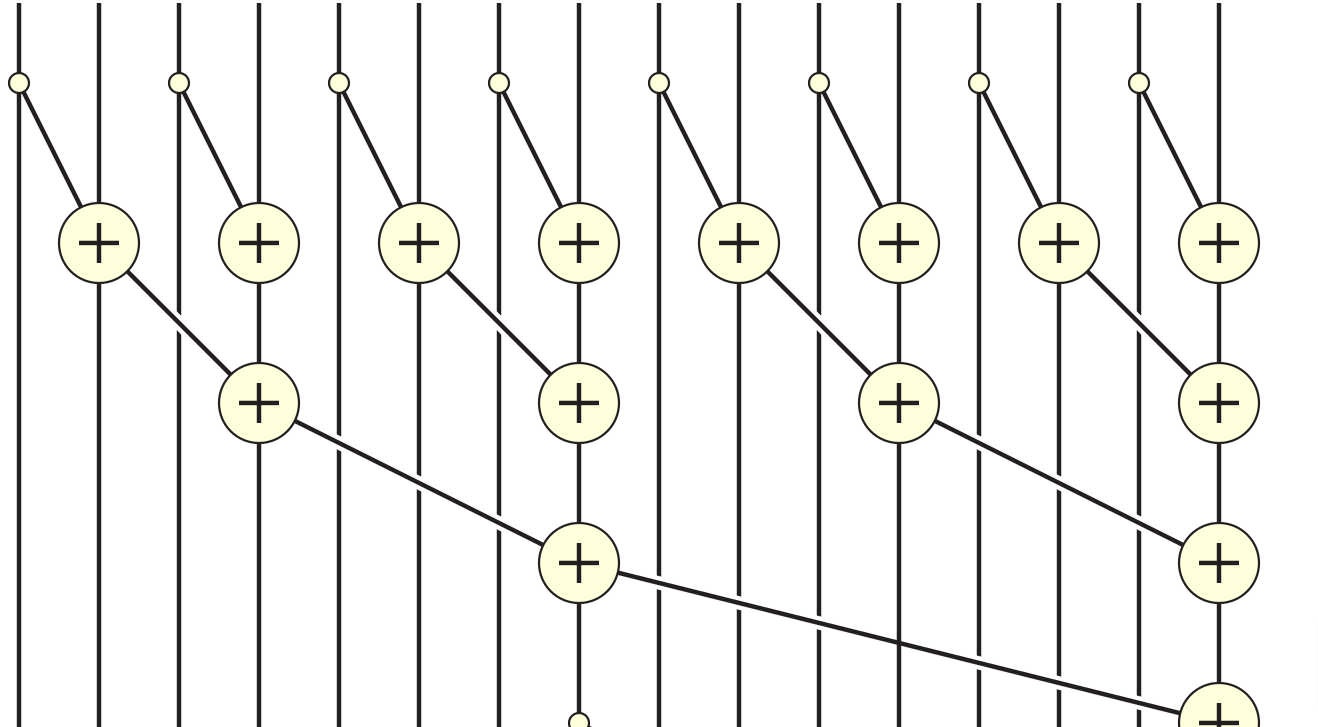
We will do this using the parallel prefix sum algorithm in shared memory. That is, each step of the algorithm should sum together half the remaining numbers. Follow this diagram:
TPB = 8
def sum_spec(a):
    out = np.zeros((a.shape[0] + TPB - 1) // TPB)
    for j, i in enumerate(range(0, a.shape[-1], TPB)):
        out[j] = a[i : i + TPB].sum()
    return out


def sum_test(cuda):
    def call(out, a, size: int) -> None:
        cache = cuda.shared.array(TPB, numba.float32)
        i = cuda.blockIdx.x * cuda.blockDim.x + cuda.threadIdx.x
        local_i = cuda.threadIdx.x
        # FILL ME IN (roughly 12 lines)

    return call


# Test 1

SIZE = 8
out = np.zeros(1)
inp = np.arange(SIZE)
problem = CudaProblem(
    "Sum (Simple)",
    sum_test,
    [inp],
    out,
    [SIZE],
    Coord(1, 1),
    Coord(TPB, 1),
    spec=sum_spec,
)
problem.show()
# Sum (Simple)

   Score (Max Per Thread):
   |  Global Reads | Global Writes |  Shared Reads | Shared Writes |
   |             0 |             0 |             0 |             0 |

problem.check()
Failed Tests.
Yours: [0.]
Spec : [28.]
Test 2
SIZE = 15
out = np.zeros(2)
inp = np.arange(SIZE)
problem = CudaProblem(
    "Sum (Full)",
    sum_test,
    [inp],
    out,
    [SIZE],
    Coord(2, 1),
    Coord(TPB, 1),
    spec=sum_spec,
)
problem.show()
# Sum (Full)

   Score (Max Per Thread):
   |  Global Reads | Global Writes |  Shared Reads | Shared Writes |
   |             0 |             0 |             0 |             0 |

problem.check()
Failed Tests.
Yours: [0. 0.]
Spec : [28. 77.]
Puzzle 13 - Axis Sum
Implement a kernel that computes a sum over each column of a and stores it in out.
TPB = 8
def sum_spec(a):
    out = np.zeros((a.shape[0], (a.shape[1] + TPB - 1) // TPB))
    for j, i in enumerate(range(0, a.shape[-1], TPB)):
        out[..., j] = a[..., i : i + TPB].sum(-1)
    return out


def axis_sum_test(cuda):
    def call(out, a, size: int) -> None:
        cache = cuda.shared.array(TPB, numba.float32)
        i = cuda.blockIdx.x * cuda.blockDim.x + cuda.threadIdx.x
        local_i = cuda.threadIdx.x
        batch = cuda.blockIdx.y
        # FILL ME IN (roughly 12 lines)

    return call


BATCH = 4
SIZE = 6
out = np.zeros((BATCH, 1))
inp = np.arange(BATCH * SIZE).reshape((BATCH, SIZE))
problem = CudaProblem(
    "Axis Sum",
    axis_sum_test,
    [inp],
    out,
    [SIZE],
    Coord(1, BATCH),
    Coord(TPB, 1),
    spec=sum_spec,
)
problem.show()
# Axis Sum

   Score (Max Per Thread):
   |  Global Reads | Global Writes |  Shared Reads | Shared Writes |
   |             0 |             0 |             0 |             0 |

problem.check()
Failed Tests.
Yours: [[0.]
 [0.]
 [0.]
 [0.]]
Spec : [[ 15.]
 [ 51.]
 [ 87.]
 [123.]]
Puzzle 14 - Matrix Multiply!
Implement a kernel that multiplies square matrices a and b and
stores the result in out.
Tip: The most efficient algorithm here will copy a block into shared memory before computing each of the individual row-column dot products. This is easy to do if the matrix fits in shared memory. Do that case first. Then update your code to compute a partial dot-product and iteratively move the part you copied into shared memory. You should be able to do the hard case in 6 global reads.
def matmul_spec(a, b):
    return a @ b


TPB = 3
def mm_oneblock_test(cuda):
    def call(out, a, b, size: int) -> None:
        a_shared = cuda.shared.array((TPB, TPB), numba.float32)
        b_shared = cuda.shared.array((TPB, TPB), numba.float32)

        i = cuda.blockIdx.x * cuda.blockDim.x + cuda.threadIdx.x
        j = cuda.blockIdx.y * cuda.blockDim.y + cuda.threadIdx.y
        local_i = cuda.threadIdx.x
        local_j = cuda.threadIdx.y
        # FILL ME IN (roughly 14 lines)

    return call

# Test 1

SIZE = 2
out = np.zeros((SIZE, SIZE))
inp1 = np.arange(SIZE * SIZE).reshape((SIZE, SIZE))
inp2 = np.arange(SIZE * SIZE).reshape((SIZE, SIZE)).T

problem = CudaProblem(
    "Matmul (Simple)",
    mm_oneblock_test,
    [inp1, inp2],
    out,
    [SIZE],
    Coord(1, 1),
    Coord(TPB, TPB),
    spec=matmul_spec,
)
problem.show(sparse=True)
# Matmul (Simple)

   Score (Max Per Thread):
   |  Global Reads | Global Writes |  Shared Reads | Shared Writes |
   |             0 |             0 |             0 |             0 |

problem.check()
Failed Tests.
Yours: [[0. 0.]
 [0. 0.]]
Spec : [[ 1  3]
 [ 3 13]]
Test 2
SIZE = 8
out = np.zeros((SIZE, SIZE))
inp1 = np.arange(SIZE * SIZE).reshape((SIZE, SIZE))
inp2 = np.arange(SIZE * SIZE).reshape((SIZE, SIZE)).T

problem = CudaProblem(
    "Matmul (Full)",
    mm_oneblock_test,
    [inp1, inp2],
    out,
    [SIZE],
    Coord(3, 3),
    Coord(TPB, TPB),
    spec=matmul_spec,
)
problem.show(sparse=True)
# Matmul (Full)

   Score (Max Per Thread):
   |  Global Reads | Global Writes |  Shared Reads | Shared Writes |
   |             0 |             0 |             0 |             0 |

problem.check()
Failed Tests.
Yours: [[0. 0. 0. 0. 0. 0. 0. 0.]
 [0. 0. 0. 0. 0. 0. 0. 0.]
 [0. 0. 0. 0. 0. 0. 0. 0.]
 [0. 0. 0. 0. 0. 0. 0. 0.]
 [0. 0. 0. 0. 0. 0. 0. 0.]
 [0. 0. 0. 0. 0. 0. 0. 0.]
 [0. 0. 0. 0. 0. 0. 0. 0.]
 [0. 0. 0. 0. 0. 0. 0. 0.]]
Spec : [[  140   364   588   812  1036  1260  1484  1708]
 [  364  1100  1836  2572  3308  4044  4780  5516]
 [  588  1836  3084  4332  5580  6828  8076  9324]
 [  812  2572  4332  6092  7852  9612 11372 13132]
 [ 1036  3308  5580  7852 10124 12396 14668 16940]
 [ 1260  4044  6828  9612 12396 15180 17964 20748]
 [ 1484  4780  8076 11372 14668 17964 21260 24556]
 [ 1708  5516  9324 13132 16940 20748 24556 28364]]